

What is ISR?
The Backhand Volley
John Yandell
ISR—internal shoulder rotation—it's an increasingly trendy term in stroke analysis. But what is it and how does it relate to the "other" paired shoulder rotation? That's external shoulder rotation or ESR.
Is it just confusing jargon? Or something real and important? It's the later.
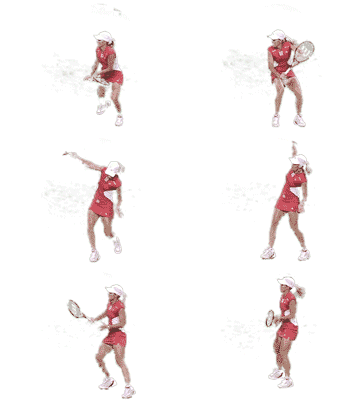
These two rotations, it turns out, are present in all the strokes: serves, backhands with one or two hands. And volleys. And they are important in the generation of racket head speed. (Click Here to see the series in the Advanced Tennis section.)
So in this final article let's see what their roles are in the backhand volley. And then ask whether they are something that you should try to consciously generate—or not.
When I first heard the term "shoulder rotation," it confused me. In tennis teaching you are used to hearing this term used as it applies to the rotation of the torso. For example on a forehand from the ready position the shoulders and the rest of the torso turn away from the net in the preparation and then rotate forward in the swing to the ball and into the followthrough.
So at least as far as tennis goes, the term is confusing. But in the academic study of the body, internal shoulder rotation means something else.
In that context, internal shoulder rotation refers to the rotation of the upper arm in the shoulder joint and not the rotation of the torso. And it's the same for external shoulder rotation.
Internal rotation is counterclockwise rotation of the upper arm. External rotation is clockwise rotation. Depending on the stroke either rotation can be first.
On the serve, for example, its external rotation followed internal rotation. You can see the sequences on all the strokes by Clicking Here.
How It Works
So let's see how it works on the backhand volley. One of the common "tips" about the backhand volley (and the forehand volley as well) is to keep the racket in front, no further back than the front edge of the body.
But that's not what really happens. What stays near the front edge of the body is the hand.
What doesn't is the racket head. The upper arm rotates counterclockwise or backwards in the should joint—internal rotation—taking the racket head back until in many cases it's actually behind the rear edge of the torso.
It can go so far until the face of the racket face is actually parallel to the court. The question is why? The answer is that it sets up the opposite or external rotation into the contact.
I don't have any numbers but it's got to be a significant contribution to racket head speed. All the top players do it to a greater or lesser extent.
Think of it as a backhanded slap and you'll feel how that adds speed. Not that you would ever want to slap anyone, of course.
Should You?
So should you? I think the answer to that isn't a simple yes or no, particularly when you are first learning the volleys.
I myself teach the shoulder turn as the backswing. That means the racket as well as the hand stay at or near the edge of the torso. (For more on backhand volley fundamentals Click Here.)
The hitting arm is in a U shape. And it moves forward to the ball as a unit. Something very close to the volleys here by Grigor Dimitrov and Tim Henman.
I think this promotes solid contact and certainly good enough speed on the volley. But beyond that there is no doubt there is more there with the further internal/external rotation component.
So that can be worthy of conscious experimentation. But more likely as you develop feel for a solid backhand volley, it's something you may just add automatically without having to think about it.
Just another case of the joys and mysteries of high level stroke production...