

Segura During
His College Career
Caroline Seebohm
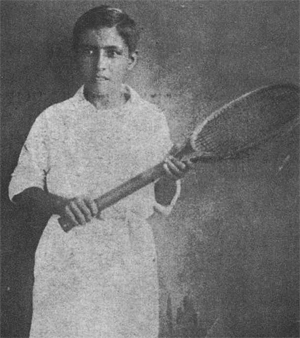
Gardnar Mulloy first saw Pancho Segura play in Guayaquil before World War II, when Mulloy was visiting Ecuador with the State Department. "When we visited these clubs we would be asked to play with the juniors, and in Guayaquil they dragged out this bandy-legged little kid. I hit with him and he was good.
"When you hit with a junior you can usually tell within five minutes if he's going to be any good or not. I said to the members of the Guayaquil Tennis Club that this kid had to get to the United States and if he ever came I'd be glad to help him."
In late in 1941, Mulloy found out first hand how good Pancho had become, when he defeated Mulloy in the Dade County Championship in Miami, 4-6, 6-1, 6-4, 8-6. The match was widely reported by the international press, who were dazzled by the speed and tenacity of the South American marvel, who had seemingly come out of nowhere to defeat Mulloy, the seven time champion.
Gardnar Mulloy was at the time the coach of the University of Miami tennis team, and thanks to his influence, Segura won a scholarship to the University of Miami starting in the fall of 1942.
The university administration was cunningly given the impression that Pancho had the required credits from Ecuador to grant him admission. "The president would keep asking, 'Where are the credits?'" Mulloy recalled. "And Pancho would say, 'They're coming next week.' Of course they never came."
Pancho proved worthy of Mulloy's trust. The following year Pancho won the East Coast Championship, the Southampton tournament (both on grass), and lost to his future coach, Gardnar Mulloy, in the final of the Inter-American Championship in Havana, Cuba.
He also won the Sugar Bowl tournament. But perhaps his greatest triumph that year was beating Mulloy again in the grass-court championships at Longwood. Mulloy didn't speak to him for a week.
At the end of the year, Segura was ranked the fourth-best amateur player in the United States behind Ted Schroeder, Frank Parker, and Gardnar Mulloy. Quite a record for a freshman at the University of Miami.
Tennis scholarships were not uncommon at Miami in that era. In 1936, Mulloy had recruited the immensely talented Bobby Riggs in the same role, but Riggs did not take to university life and immediately began skipping his classes.
Riggs made a proposal to the college president that he should simply play tennis in tournaments across the country, publicizing the University of Miami, and be awarded his diploma. That idea was immediately rejected and Riggs disappeared back home to California after only about a month in school.
Pancho Segura was made of sterner stuff. He knew he had to make his way more carefully. With no money and few contacts, his best bet was to study well, improve his tennis, and keep his head down. The University of Miami gave him food, a roof over his head, and unlimited access to tennis courts run by a brilliant coach who was also an elite player.
Segura was placed in a dormitory with a group of football players. The physical incongruity could hardly have been more extreme, Segura and two hundred pound athletes. His English was still minimal.
The football players had laughs at his expense. One example was at a bar. "See that gorgeous girl over there? Go over there and say, I want to make love to you. She'll really like you if you say that." The result was a slap in the face.
Pancho didn't mind. It was all valuable exposure for him to American customs, American language, American jokes, clues about the culture he was later able to exploit so brilliantly.
"There were only two Spanish-speaking students in a class of 2,500," he said. "I had to learn fast. I used to go to the dining room an hour before the football players got there because otherwise I knew the food would be gone!"
His classmates were mostly rich. "They all had cars. I used to take a bus to the city of Miami. But I had a good friend who loved tennis, and he would drive me around or lend me his car. He was on the tennis team and I beat him all the time."
Pancho was there for the tennis, but he embraced the rest of his university career eagerly and began to exercise an intelligence that went far beyond tennis strategy. He applied for classes he thought he might have a chance of passing, including forestry and business administration. Mulloy used to tease him later by saying he majored in basket weaving and Spanish.
But the subjects he liked best were politics, current affairs, and history. "I liked listening to the class discussions. I learned a lot by listening. I sat next to the most unattractive girls. They were always the brightest and got the awards. I thought if I sat next to them their knowledge would rub off on me. The pretty ones were always talking about themselves and who they were going out with."
Not that pretty girls weren't interesting to him. "I went to the beach and this girl put cream on my back and I didn't know what to do, I was so nervous!"
In South America, women were thought of as saints and virgins, not to be touched until after marriage. The loose, wild sex lives of the students he was surrounded by was shocking and frustrating. "In Miami, all those girls, so many, and I just wanted one!"
Gardnar Mulloy was well aware of the pressures on his young recruit. He was coaching Pancho very hard and found him to be a responsive student. "He got better and better." But Mulloy was not about to let him get distracted by other things.
"He used to tell me to stay away from girls,” Pancho said. It's not clear whether Mulloy, who was tall and extremely handsome, took his own advice.
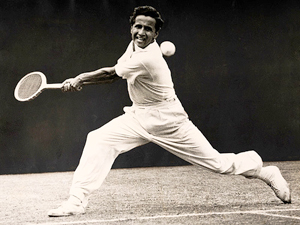
Pancho Segura won the NCAA Intercollegiate singles championship for the University of Miami three years in a row, 1943, 1944, and 1945. More than 70 years later that is still the record.
In every match he was much smaller and lighter than his opponents. One of them, Tom Brown of Stanford, was considered at the level of Jack Kramer and became Wimbledon doubles champion with Kramer in 1946. (Click Here for Tom Brown's memoirs.)
"That was a fantastic win for me," Pancho recalled. "I was like Jimmy Connors or Lleyton Hewitt, 100 percent on every shot, with great concentration. I overcame my handicaps in size and weight.
"In my mind I thought I could win. I showed I had the potential, and that my coach was right to put his trust in me. Mulloy was with me all the way. He told me I would put the school on the tennis map and I did."
Pancho did not graduate--he did not pass enough courses. But he learned more during his university years than he could ever have learned from his professors. Instead of an academic diploma, he earned a degree in the American Way of Life.
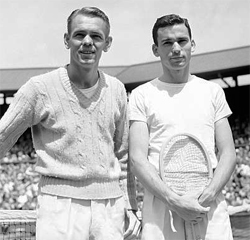
By being around these confident young Miami college kids, he saw the promise of America. He was tasting the possibilities he was never going to forget. "If it weren't for tennis," he would say, "I'd be with all the other Indians chasing alligators in Florida's amusement parks."
Gardnar Mulloy continued generously to promote his Indian star and saw to it that he made appearances elsewhere, further enhancing his standing. In January 1943, Pancho won the Pan American Championship in Mexico, and that summer he won the Eastern Grass Court Championship, the Southampton tournament and an important exhibition match in Miami, where he beat the man then considered the best player in the world, Don Budge.
After Pancho's semifinal win at Southampton's Meadow Club that August, New York Times writer Allison Danzig once again showered praise on the outsider. Rightly predicting that Segura would win the tournament (in a tough three-set match agamst the former Wimbledon champion Sidney B. Wood Jr.), Danzig devoted his whole Sports of the Times column to Pancho's career so far.
Danzig described the usual North American attitude to South America as "steel guitars, castanets, the swirling skirts of a Carmen Miranda and polo ponies," and declared that this human dynamo from Guayaquil Ecuador was going to change all that. Danzig went on to say that considering the other top ten names in tennis, "Segura stands as the man to beat."
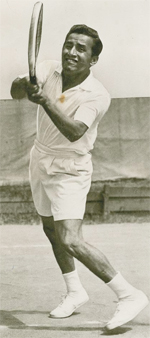
The column, which dominated the sports pages of the newspaper, was courageous, not only for its daring promotion of a young Latino in the clubby society of amateur tennis, but also for its bold declaration about Pancho's future in the game.
"Segura stands as the most colorful figure to pull the crowd into the stadium," DanzIg wrote. "The friends he is making with his sportsmanship and good nature, as well as his success on the courts, will bring in plenty for himself in the years ahead."
Such lavish and admiring coverage from the top tennis writer at the New York Times was a tribute to Segura's impact on the world of tennis after only 3 years in the states. Danzig's column, translated into Spanish, was printed in full the next day in Guayaquil and the town went wild.
In 1944, Pancho won the Western Championship and U.S. Clay Court titles. He again won the Southampton tournament, and in 1945, after winning the Pan American tournament again and the U.S. Clay Court doubles championship with Bill Talbert, he retired the Meadow Club cup by winning the Southampton tournament three years in a row. What better payback for his lackluster debut five years earlier? (Click Here.)
At the end of 1945, with his triple win of the Intercollegiate singles for Miami, and having also reached the semis of the U.S. Nationals at Forest Hills three years in a row, Pancho Segura ranked third in the amateur standings behind Frank Parker and Bill Talbert.
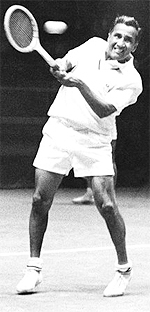
While the world war was taking its toll on the larger stage abroad, Pancho crisscrossed the country playing tennis. Because of his legs he was rated 4F and could not be drafted. Instead he played exhibition games at U.S. army and navy bases, traveling everywhere by Greyhound bus.
"I was a vagabond," he said. He went to Nassau in the Bahamas. He played wherever and whenever he could, indoors and outdoors. All the time, he was constantly refining his tennis, particularly on grass. He worked on his net play, on his backhand, and on his serve. He was a ferocious, tireless competitor and the darling of the fans.
But when the war was over, and the great amateur players who had signed up for active service came home, the tennis scene looked very different. In 1946 Pancho won the National· Indoor title, the Queen of England's Cup, and the Pan American tournament in Mexico (for the third time).
But these were not major titles. The top American players, Don Budge, lack Kramer, Ted Schroeder, and Frank Parker, had all quickly returned to big time tennis, and Segura soon lost his high ranking. The competition was fierce.
Pancho's future suddenly looked less promising. Perhaps Danzig's optimism had been misplaced. There was talk about him going home, something he refused even to consider. He made only one brief trip back to Guayaquil in 1945, where he was welcomed like a god.
He again began to worry desperately about money, and not only for himself this time. Segura had fallen in love. But how could he get married? Then in late 1947, Jack Harris, the only successful professional tennis promoter in the country, invited Pancho Segura to join his tour. It was the biggest decision of this career.