

Why I Like the Pinpoint
Pat Dougherty
As the "Serve Doctor" based out of IMG Academy, my longtime friend John Yandell asked me to weigh in on the debate over whether the platform or pinpoint stance is better.
I'm often asked, "Who's got the best serve?" First off, the effectiveness of serve technique involves many aspects beginning with the holding of serve capability. As a weapon, you can over-power the returner, you can win with placement precision and strategic use of the full array of serves beyond flat power integrating topspin, slice and kick serves.
Lastly, managing a healthy first serve percentage along the way to not live too often off your second serve starting too many points. So, it's not an easy measurement of just power threat and chosen style of serve technique.
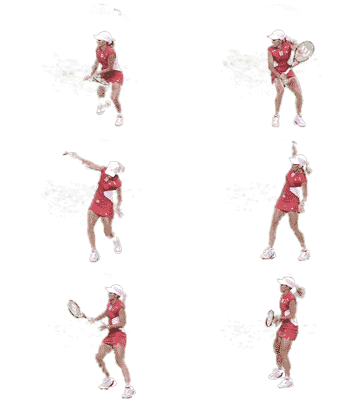
As most of you are aware, all servers begin the motion with some variation of a platform stance with feet separated. Pinpoint stance occurs while loading the motion into set-to-launch position as the toss arm extends upward, and the backfoot repositions forward next to the front foot.
The Platform Stance
Federer, Djokovic, Sampras and Dimitrov are all platform servers who used spot placement serving accuracy as a weapon. In addition, they have a great tactical plan of using variety of speeds and spins to set up flat serve opportunities on first serves and set up combinations of serve plus one on both 1st and 2nd serve scenarios. However, they were not known for having the biggest power serves in the game.
Platform servers share many of the same key fundamentals as a pinpoint. If you watch Federer or Dimitrov, you'll see his weight shift fully forward with toss release and his hips penetrate the plane of the baseline then rise upward towards the contact point.
This forward shift and upward driving hips occur with the body weight predominantly on the front leg. With his chest angled upward towards the contact, his tossing arm can better tap into the power of the kinetic chain like pitchers using the glove arm to power the rotation of the shoulder mechanics.
A full continental grip combined with a relaxed hitting arm enable the energy to pass through and accelerate racquet head speed upward to turn over into contact at full arm extension. Like the crack of a whip, all the effort, energy and power is directed upwards towards the ball as opposed to forward and down towards the court.
He finished with both feet inside the baseline ready to split and react to the return. The biggest influence on Federer's serve motion was Sampras.
Many years ago, Djokovic struggled with is serve for period of time. It's quite common that while they have a balanced stance, plaform servers can have issues. If the body doesn't flow forward and upward, they begin to rely too much on the back leg in their upward launch.
The See-Saw
The "See-Saw" only requires one fulcrum of support, not two. When the launch sequence has conflicts with the back leg overpowering the contribution of the front leg, things will go wrong.
The front leg is the preferred support and driving fulcrum that the shoulder mechanics need as they elevate the body upwards. When the "center of gravity" (hips area) remains split between the feet for launch, often the leg thrust jack knifes the hips backward causing the feet to remain behind the baseline on finish and sends the ball into the net.
Ultimately, with all the issues I encounter and limitations of ultimate power potential, the platform stance is not my preference when building developing young player's serves from the beginning. (For one alternative view, check out my article on the Federer model. Click Here.)
The Pinpoint Serve
This stance is popular among top players with big serve weapons like Roddick, Shelton, Sinner, Medvedev, Zverev and many others. The benefits of the Pinpoint far outweigh the negatives in my opinion.
The Pinpoint technique shares many of the same fundamentals that are critical to optimizing the Platform as well. The importance of achieving chest aimed upward for launch to contact enables the shoulder mechanics to execute full use of the kinetic chain flowing from the toss side driving energy to the hitting side.
Most players think significant knee bend for jumping up to contact is where the majority of power comes from and as they build their motion that becomes their priority. Not to discount the contribution from the lower body but there are wheelchair players who hit well over 90 MPH in a wheelchair though they may be paralyzed from the waist down.
The design of their wheelchairs enable them to lay back on the serve enough to achieve chest upward alignment towards contact and incorporate full use of the shoulder mechanics to reach those speeds.
So, obviously it's not coming from the use of the legs. I focus my players" priorities around chest angle and let the lower body flex into position to accommodate chest up.
The starting stance is important in how your feet are positioned relative to the baseline. Having worked with multitudes of Asian players, the vast majority start parallel to the baseline.
Can it work well? It can if you have well developed pitching/throwing mechanics and aggressively rotate the upper body into contact while elevating off the ground like McEnroe and Sampras. Without those qualities, the feet parallel to the baseline can limit the range of serve placements.
My preference is to position the body and front foot pointed more in the direction of the corresponding net post. This enables the body to shift under the point of contact, penetrate the plane of the baseline and maintain balance better. At the same time, the forward shift over the toes taps into a power source provided by the hip flexors. I often use as a conceptual model I call the limbo position for shifting forward into the launch to contact position. This achieves the chest angle up and the lower body accommodates.
It creates a pole vaulter's bent pole position loaded for upward launch. With all the balance on the front foot, chest aimed upward and shoulder plane aligned from elbow to elbow pointed at contact, the snap action of the body takes you off the ground to full extension of body and arm at contact with the footwork landing inside the baseline. This forward momentum on finish opens options to move forward to Serve/volley or approach.
Winding A Spring
Bringing the back foot forward to pinpoint opens up another power source of hip and shoulder separation like winding a spring. The hips winding forward as the shoulders wind in the opposite direction.
So we have several power sources incorporated based on simple models. The See-Saw, the pole vault snap, the uncoiling of a spring that all occur on a base of support of just the ball of the front foot! Amazing but not that difficult to develop. I am a big advocate of the Pinpoint stance.