


The World of Modern Strings
A.J. Chabria
The only part of the frame that touches the ball is the string. For this reason a friend and mentor of mine calls rackets “stringholders."
So you look inside your racket bag and there is a frame with a broken string, or you buy a new frame. I see potential. You have a vast number of stringing choices. (For my article on frames and customizing them, Click Here.)
But what does the universe of potential stringing look like? How do you evaluate which way to go? There are no absolute answers.
In this article I will outline the complex, often bewildering options and string combinations available to players today. Then in the next article I will make some specific recommendations for players at all levels of ability and experience. And discuss the vital topic of string choice and arm health.
History
Having strung my frames and those of hundreds of players over the past 4 decades, I have seen all the string trends come and go. It didn't used to be this complex.
In the wood, metal, and early graphite era, strings were generally either natural intestines from animals, or woven nylon fibers.
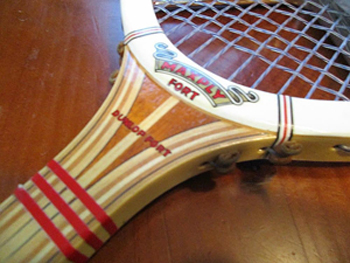
Many of us started tennis with simple nylon. Soft. Easy to string. Inexpensive. Often players had one frame strung with nylon and one with gut.
Some gut brands were less coated, and felt remarkable against the felt of a ball, but did not handle humidity well. Others were coated but took time to break in.
I remember Ivan Lendl paying a guy I knew, to hit for precisely thirty minutes with his freshly strung full gut beds. Compare that to today when elite players ask for all their sticks to be strung together, by the same stringer, with time stamps.
Then synthetic gut strings started to emerge and they were a big upgrade from simple nylon. They were generally single core strings with a coating which gave tension maintenance and durability. Some were wrapped with a single or double layer which gave more bite or feel.
They were inexpensive and comfortable. Good but not great with power, control, durability, and--even after decades of development--mediocre at holding tension.
The world started to change again when kevlars and early polyester monofilaments debuted in the seventies and eighties. The first polys were very hard and gnarly to string. They felt heavy and clunky in a small headed frame. But they lasted and gave good spin if strung at low enough tensions.
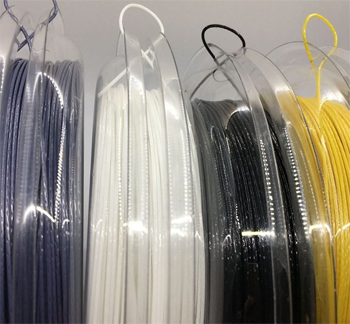
Kevlars were full of control, did not elongate much, lasted well, but did not spin the ball well. Still they could feel good when paired with a softer cross string. Their durability was bullet proof.
Co-Poly
Some companies are still making kevlars and single filament polys. But a new generation called co-poly has now taken over the market. Co-polys are widely used, even by players who, in my opinion, should not be using them.
Why have poly and co-poly come to dominate in the pro game? Spin. Because these strings are so hard and slick, they slide and snap back, and at least initially don't notch. The ball comes into the string bed. The main strings slide down. As the ball starts to leave the strings, the mains snap back imparting additional spin of up to 20% or more. How is all this known? Super high speed video, some filmed at up to 15,000 frames a second or more. There is a great article on Tennisplayer by Josh Speakman that explains some of the research and the poly effect. (Click Here.)
There is also an amazing collection of high speed video in the Tennisplayer archives with dozens of examples that show how these strings behave in the frames of actual top players. (Click Here to see the forehands.)
Options
So let's look at the co-poly options, and also the many possible hybrid combinations, either all co-poly or co-poly paired with synthetic or natural gut.
With so many choices out there, it is important for players and coaches to choose wisely, and especially not feel limited by the most common products on the racks. In these articles I won't get into specific brands. I am compensated by some. I play test others. I purchase others. But mostly, the premium, successful brands we all know are great in their own ways.
Basically there are three categories: budget, extreme durability, and performance. But beyond that there is another distinction. Full beds of the same string or hybrids?
Extreme Durability
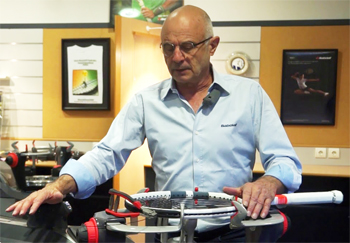
This is an expression used frequently by the great Lucien Nogues, one of the finest minds in tennis engineering. Nogues is one of Babolat's top stringing experts. He has worked as a stringer on the pro tour for many years, with a résumé that currently encompasses 55 major tournaments.
I had an occasion to meet him, and learn from him during a Davis Cup tie here in the States. He said this about tightly strung poly. "Polyester monofilament strings are for one thing. Extreme durability. Nadal."
At the time I thought, well, I like poly for control, and I love its sliding and snapping back as it spins the ball violently.
But undeniably, the hardness of polyester string, and its resistance to notching, are its main strengths. If you hit big enough to break poly, you probably appreciate its durability.
But if you don't break poly, you might be leaving it in your frame too long, and even compromising your arm health. It loses tension quickly, then feels stiffer and deader within a week. If you string it too tightly, you miss out on the sliding and snapping effect, so you're losing some good spin potential.
Performance
When it comes to performance natural gut tops the category. In every study, it gets the highest marks in elasticity, resilience, and tension maintenance. It's arm-friendly, even at high tensions. Not durable.
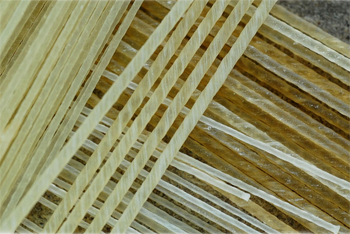
Multifilament synthetics, comprised of many microscopic filaments feel excellent to most players. They pocket the ball almost as well as gut, and deliver arm-friendly power. Durability is not great for big hitters. Tension maintenance can be just passable.
Supermulti is a word we hear nowadays, describing a string that includes co-poly but trys to blend the comfort, power, and feel of a soft string with spin potential.
Some are multifilament coated with harder polymers. At first, the coatings on these slip nicely, then wear out and notch. Then they fray, then snap.
Some are really monofilaments, made out of soft materials. Strung low, they feel very comfortable and soft, but they do offer the control and spin potential of a true poly. This is a strong and economical alternative to natural gut, but only marginally more durable. This category isn't complete without a mention of the softer co-polys, designed for full beds at low to moderate tensions for playability, spin, control, and a bit more comfort than the firmer polys of yesteryear.
Hybrids
Hybrids are in my opinion, the way for a coach or stringer to dial in just what a player needs. According to a Babolat executive, forty percent of the frames strung at Roland Garros were hybrids. Most of those had some gut in the mix. Here are some popular options today.

I personally use natural gut mains with a poly cross. The most spin potential ever tested was a natural gut main with a thin, hard poly cross. The gut offers power. The poly blunts it a bit, but more than makes up by allowing the gut to slip and snap freely. Choose too thin a poly, and it will break the gut quickly. Too thick and you might leave some spin on the table.
A textured poly grabs the ball well, and slips well until it notches. But an edgy or textured poly can saw through the gut quickly. Substituting a multifilament main is a good option if the gut is too expensive for some players.
Roger Federer plays with gut mains and poly crosses, and so does Djokovic. The softer the poly, the more comfort you will feel. But too soft, and it notches. The gut mains retain tension so well, the poly's deadness seems to be a non issue.
A Poly main with gut or a multifilament cross string can offer a similar feel with better durability than a gut main. Not quite the power and spin of the reverse, but close. And way better on the budget.
Another option. A thick poly main, for durability, and a thin poly cross. Great spin. Extreme durability. Not arm friendly after a while. Break it or cut it after a few days.
A durable thick multifilament main with natural gut crosses. Big power, great feel, arm-friendly, and economical if the multi is thick enough to last you. Not even close to the top of list in spin potential. But I think very smart for most players—more on this in the next article.
Yet another possibility. Poly mains with a soft synthetic gut cross. Popular with juniors who don't want arm pain. This is similar to having a kevlar main and a softer cross.
Tensions
Almost all polyester manufacturers recommend dropping tension five to ten percent from the reference tension you would use on gut or a synthetic. This is smart even with a supermulti or a soft monofilament synthetic. They just work (slip, snap, deflect, rebound) better at lower tensions.
I realize a lot of us who've been playing for decades are used to a certain reference tension number in the sixties or high fifties, but it is time to let that drop unless you're Stan Wawrinka.

Some stringers like going lower on crosses because it is a shorter distance compared to a main. This gives a livelier feel to the bed. I have done this for decades.
Others actually like tighter crosses so the main will slip more readily across a tighter cross. That makes sense for spin potential. I'm effectively doing this by only dropping cross-string tension two pounds from the tension of the mains.
There are negatives of even just a half set of natural gut. It is expensive. Not all stringers know how to handle it. If it breaks on the machine it is the stringer's responsibility, but often a poorly strung frame breaks in say, nine hours instead of fifteen.
Why? Friction burn accounts for some premature breaks. Overly aggressive stringers using sharp tools can bruise or nick the gut on knots. Hit it off center really hard and it can break, especially in today's stiffer frames.
So if you are intrigued but maybe confused by all the options, it's understandable. Stay tuned for some starting recommendations if you decide to pursue the path toward your ultimate string bed.