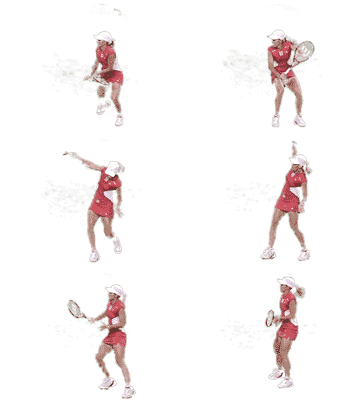


Fade vs Draw
Chuck Tomlin
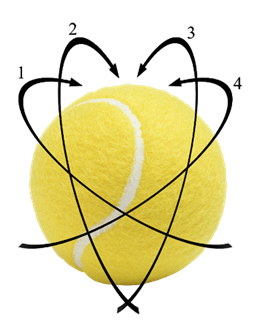
This is a brief outline that shares many of the important aspects of groundstrokes that can be enhanced by knowing how to use the Fade vs Draw Top-Spin Paradigm to augment the older Flat Drive vs Lifting Spin dichotomy.
Fade refers to the Spin put on the ball at contact, that will cause the ball to curve to the outside or away from the direction of the arc of the player's swing. An example is an opposite field hit in baseball.
Draw refers to the spin put on the ball at contact, that if sufficient, will cause the ball to curve or swerve in the same direction as the general arc of the swing path like a 'hook' in golf.
It is important to note this is used to describe the spin that a stroke will produce, because the horizontal curve of the ball flight may or may not actually be noticeably observable. While a horizontal curve of the shot may be useful for many reasons, it is not a primary reason for employing this concept, but instead this curve is a welcomed byproduct. These spins are not limited to Topspin, as Slices can be hit with Fade or Draw as well. For this article, the focus is on Top-Spin shots.
The Benefits of Using Fade and Draw Spin Technique Paradigm
- It Expands the Vertical Hitting zone greatly
- It Extends the Horizontal Hitting zone greatly
- It explains the benefits of different wrist positions at Contact,
as well as other key technical variations - It provides much greater meaning to "Ball Reception" and insight into the nature of the contact
- It enhances Consistency and Amplitude of shot results via Shot Matching
- It encourages players entry to the Zone or a Flow State
- It provides substantial insight into adapting to opponent's strengths, weaknesses, and styles
1. It Expands the Vertical Hitting Zone Greatly
When you seek to meet every shot with a contact at the same height (such a navel high that is often taught), at best you have 2 possible contact points. One as the ball bounces up past your waist and the other as it drops back down to that level. This becomes one limited contact point if you don't have the skill or speed to hit a rising ball. Waist high contact isn't even an option if the bounce of the ball is not up to the level of your navel.
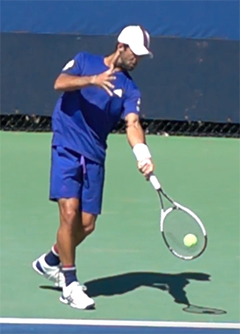
Once you learn to employ the Fade or Draw spin, your effective and comfortable hitting zone grows massively from just above the ankles to slightly above your eyes. When you master hitting the Fade Drive well, the most aggressive shot and the one you are looking to hit as often as possible, is the Fade with contact up around shoulder height. The game becomes a bit like volleyball, where this Fade Drive is the "Spike" and the other shots are mostly about setting this one up.
2. It Extends the Horizontal Hitting Zone Greatly
As you Expand the hitting zone as discussed above, this allows you to alter your depth of Ball Reception greatly to suit your Tactics and Strategy.
At times you may want to hang back more like Nadal, allowing the ball to drop so that you can really 'lift and spin' your Draw return, causing it to kick up strongly off the court. In other situations, you may look to move in more to take balls that are shallower in the court to push the action with aggressive Fade Drives.
The important point here is that it becomes your choice and gives you the skills to largely take control over this aspect of the game.
3. It Explains the Benefits of Different Wrist Positions at Contact as Well as
Other Key Technical Variations
If a player intends to hook or draw a shot back in, as with the famous Nadal banana shot (an extreme Draw), then the wrist will adjust to a position that accommodates getting the racket head out ahead of the hand for contact.
This stands in contrast to when a player seeks to Drive the ball from a more inside contact (as we often see with rising ball and higher contacts above the chest) where the wrist will often remain more laid back for Fade contact. When you have the intent to impact the ball in a certain way, this resolves how the wrist will be positioned to accomplish the goal.
4. It Provides Much Greater Meaning to "Ball Reception" and Insight Into the Nature
of the Contact
At the point that you have learned to recognize early if you will use Fade or Draw spin (also factored with Drive vs Lifting {a 2nd associated pair), you will then adjust your positioning to better accomplish that task. With practice, you will learn to position better consciously and later unconsciously. There are many variations you face as a player but knowing the type of Top Spin profile you intend to hit is vital to getting the body organized to hit the shot well. The nature of contact should also adjust subtly between contacts depending on more Spin amplitude vs more Drive amplitude.
5. It Enhances Consistency and Amplitude of Shot Results via Shot Matching
Better incoming Shot Recognition, Ball Reception, Congruence of Technique, all lead to better "Shot Matching" intent for your strokes. Understanding the type of Top-Spins you have available sets off a cascade of improvements in almost every aspect of shot making.
You will better understand how to employ margins of error for your targets and the demands your shot will force on your opponent. This is much better than missing wide because you didn't account for the type of Spin caused by unconscious compensation due to a high or low contact point.
For example, moving inside the baseline to Attack with a Power Fade Drive like Federer should keep the ball low and penetrating as it greatly limits the opponents' reaction time and reply options. Contrast this with the Rafa forehand kicking bounce that uses abrupt height to challenge the opponent's contact zone.
6. It Encourages Players to Enter to the Zone or a Flow State
As you master hitting Fade and Draw spins on demand, you will begin to see a pattern of thought emerge that becomes a very familiar, simple process. You learn to watch your opponent's swing, look for newly recognizable keys that indicate how their shot will perform. Using these keys, you (1) Recognize the opponent's shot type. With this, you (2) Select your preferred shot reply and move to optimize your (3) Receiving position for your shot. Having a specific shot intent tends to make the movement to receive the ball much more purposeful. The last part of this Loop of Shot Matching is to (4) Execute and Recover to repeat this simple but consequential Shot cycle during points.
This Loop is an active & mindful practice of observing what is happening in the present moment of every shot sequence, often creating a Flow State.
7. It Provides Substantial Insight Into Adapting to Opponent's Strengths, weaknesses and styles
While overall Skill level tends to rule the day, there are general patterns we can see when players skills are nearly equal. While often unnoticed, much of a player's Style comes from his tendency to favor the Fade or favor the Draw spin types.
Nadal is a great example with his unique style. Rafa is well known for his forehands with heavy spin rates and high net clearance that really force the ball to kick up high in the opponent's strike zone. To do this, he tends to play deeper behind the baseline than most players, which gives the ball more time to slow down and drop from the peak of the bounce.
This extra time allows him to run around more backhands, run down more balls in general, all while using the dropping ball to augment his heavy Draw spin rates with a steep upward swing. With this style he can be aggressive and consistent at the same time, while applying heavy pressure to players who are not so adept with high contact points (especially to their backhands). Only Novak and Davydenko have the movement and high contact point skills on the backhand to best Rafa head-to-head with over 10 matches played.
The Fade and Draw paradigm provides a "ripple effect" to shot execution. That is, by understanding and using this method you create better shot quality from a greater number of positions and circumstances, more consistently and more often.