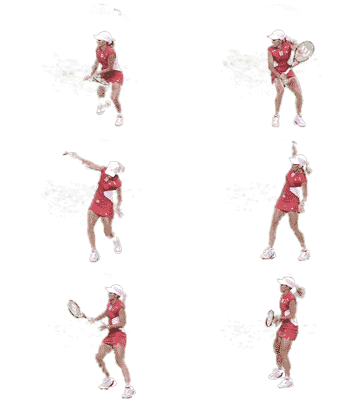


Donna Vekic's Serve Vs. Coco Gauff's
Similarities and Differences
Sean O’Neil

When developing a new player's game, the teaching professional's goals are centered around developing efficient, repeatable swings that will hold up under pressure. The simpler the motion, the more likely it's able to handle stress. When building the foundation of a player's game, you take their natural ability and mold it into a style of play that matches their personality. With proper biomechanical instruction, a player's game will continue to develop as they gain more and more tournament experience. Mechanics that are limiting will eventually cause the player's game to plateau and their development will be stunted.
Complicated, limiting mechanics will decrease the likelihood of that stroke holding up under pressure. Players will start to develop "cracks" in the "foundation" of their game, increasing the likelihood of their strokes collapsing. Maintaining confidence under these conditions is extremely difficult. Soon the lack of confidence becomes a "self-fulfilling prophecy" and the player soon expects to fail. All players on the professional tennis tour have achieved great heights but can still be subject to these breakdowns.

When I first thought about how I wanted to write this article, I was just going to write exclusively on Donna Vekic's serve. But the more I formulated a template for the article, I noticed similarities between how Ms. Vekic hit her serve and observations I made about Coco Gauff's second serve, in a June 2024 edition article (click here).
I concluded that it might be a better article if I discussed the similarities and differences between these two servers and the limitations, they have that might cause breakdowns under the stress of tournament match play.
Ms. Vekic is a Crotian player whose highest ranking reached #19 in the world in November of 2019 and has won 4 career titles. Currently she holds a world ranking of #39. Ms. Gauff is known to most tennis players and has taken the tennis world by storm. She has already won last year's US Open and currently holds the world ranking of #2 in the world.
With that in mind, the similarities will be as follows: 1) Synchronization of ball toss and leg drive. 2) "Forward entry" of the racquet head drop. 3) Limited Internal Shoulder Rotation through contact. The differences will be: 1) How "trophy position" is achieved. 2) Eyes at contact. Keep in mind that the similarities are counterproductive while the differences may favor one or the other player, depending on the circumstance.
Similarity #1

Synchronization of ball toss and leg drive - Both players release the ball in their toss well before the knees have begun to load. The old teaching adage for the ball toss is "knees bend down as the toss goes up". This ensures proper storage of energy in the legs for the later ground-reaction forces exploding up.
When the kinetic chain is broken, a series of convoluted motions may be required to make up the difference. Both players have very slight lateral pinpoint stances which could limit rear hip loading. This plus the leg/toss issue, make for an inauspicious start to their service motions. If more complicated motions are required later, the players will continually fight against themselves to maintain a professional tour level serve that can't be exposed by their opponents.
Similarity #2

"Forward entry" of racquet head drop – Racquet drops will usually follow one of three types of entries: lateral, diagonal or forward. The lateral entry has the racquet head dropping more straight down but puts more stress on the shoulder joint. Over time, the stress of this may take a toll. The diagonal entry is the most preferred method where the racquet head will disappear behind the servers' head.
If you're looking at the server from a side view the racquet will drop on "edge" and disappear. Most elite servers use this method. A forward entry of the racquet dooms the racquet path to more of a front and back motion that severely limits the ability to externally rotate the shoulder. A player's serving goal (as well as all other strokes) should be to reach 100% of their potential. Less external shoulder rotation leads to less internal shoulder rotation thus limiting the most important power source. We'll discuss Internal shoulder rotation next.
Similarity #3
Limited internal shoulder rotation – The external to internal combination makes up approximately 40 – 45% of racquet head speed at contact. It's the largest power contributor in the service motion. If this dominant power source is compromised, it greatly inhibits the ability to consistently hit with power. The ideal racquet head path is for the racquet head to approach contact "on edge" and finish on the opposite "edge", after contact.
A swing with less than a full 180 degrees of shoulder rotation is limiting their service potential. Donna tends to finish with her racquet strings pointing down towards the court, while on some of my videos, Coco sometimes doesn't even reach that position. Other video examples are better than these but it's the lack of consistency that is a big concern.
Difference #1
How the "trophy position" is achieved - Ms. Vekic has a fuller backswing where her arms go "down together and up together" but she has developed a "hitch" in her motion. This extra motion can complicate the entire service motion and possibly lead to breakdowns, particularly under extreme pressure. The "hitch" is demonstrated when both her left and right arms go up high in the air when the ball is released. It's like she is reaching up high in the air with both arms. She will later drop her right elbow, till it moves in line with her shoulders. This added motion is another example of wasted motion that could haunt her swing at the most inopportune times.
Coco doesn't have this "hitch", she achieves her "trophy position" directly with her abbreviated takeback. The tennis teaching community desires more of a direct line from shoulder to shoulder to elbow in the takeback. It's a more efficient backswing and should be more dependable when she needs it most.
Difference #2
Eyes at contact – Notice how Donna keeps her head more upright at contact with her eyes looking at the ball. This helps to have more of an upward trajectory in her swing. Your racquet should have an upwards swing path before the internal shoulder rotation and wrist flexion (to neutral) occur.
The location of Coco's eyes at contact astounded me. Her head is completely down with her eyes looking forward. Nowhere close to looking up at the ball. She uses more of a "pull down" motion which is demonstrated by a pulling of the arm through the hitting zone using the trunk. Dr. Ben Kilber describes this "pull down" method in video form under the "biomechanics" section of tennisplayer. As he states, "the problems with this type of serve are decreased ball velocity, decreased spin and increased injury risk". This could be one of the contributing factors in Coco's second serve difficulties.
In a nutshell, every player has their own unique style and personality of hitting a tennis ball. The best players have biomechanically sound techniques that allow their games to grow and hopefully reach their potential. Others have limiting factors built into their mechanics that will "stunt" development and doom them to a more difficult road to success. I have always felt that building one's game around sound biomechanics is critically important to a player, especially early in their development.
At the top levels of the professional game, if a player has any "cracks in their fountain", the desired results may be harder to come by. Both Donna Vekic and Coco Gauff are extraordinary tennis players who have reached rare heights in the game. Both do have some limiting stroke technique that can be exploited against the most elite players. Life on the tour is not conducive to making changes to one's game. Each player must decide if the time required is worth the investment involved. Sometimes it's not worth the investment and the player just finds a way to disguise or minimize the effects of the flaw.