


Modern Equipment
and Arm Health
A.J. Chabria
In the first two articles in this series we explored custom rackets (Click Here) and different string compositions and the myriad choices. (Click Here) Now let's focus on modern equipment as it relates to arm health.
Many factors can contribute to injury: biomechanical elements, overuse, and also undertraining. But here let's examine the influence of the racket, the strings and the grip.
First though a historical question. Why did so few players, both frequent and casual, not get tennis elbow (technically medial and lateral epicondyalitis) during the tennis boom in the seventies?
Rackets were heavy wooden frames with much larger grips, strung in the 55-70 pound range. Suspect technique abounded back then just like today, but fewer players complained of wrist, elbow, and shoulder pain.
Strings were softer. Grips were larger. Frames were heavier. There are implications here for us today.
Of course nobody is going back to that era, although some skilled tennis players I know, do occasionally add fresh strings and grips to a vintage wood frame and enjoy a few minutes of retro tennis.
That's not modern tennis. There has been obviously a complete equipment revolution. The reality is that if a player's physicality, durability, and mechanics can handle a stiff, modern, light frame with a smallish grip, she or he will use it well, and in good health.
That's not the case though with some players who suffer everything from occasional to debilitating arm pain. When that's the reality, there are numerous lab studies that outline possible solutions. These include:
My Own Case
Let's examine these factors through a series of case studies and begin with me. The two times I have ever suffered from arm pain, there were two different factors. First a four week dalliance with a stiff frame under 320g. Second, I left the poly in my frames for too long.
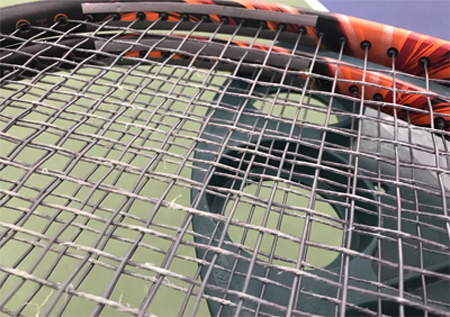
As mentioned in the last article in this series, I use natural gut mains and poly crosses. The gut breaks at about the time the poly begins to die. It almost feels like the gut makes the poly stay lively longer. So I eliminated the pain by adding mass to the handle, not waiting for the gut to break and restringing more often.
4.0 Woman
A 4.0 woman with a very light frame and clean technique was just not breaking the strings and so left her poly mains in too long. This was difficult on her wrist and elbow. Went back to gut mains. Happy. Recently switched to a multifilament synthetic, and is even happier with the comfort and the price point.
Nationally Ranked Junior
A 15 year old nationally ranked junior. Guilty of overuse. Addicted to the control and “stupid spin" of poly at 50 pounds. Breaks strings weekly. Encountered consistent elbow pain, despite frequent restringing. Went to 48 pounds and did a better job of stretching. Went from a 4 and 1/4 grip to a 4 and 3/8. Success.
Teaching Pro
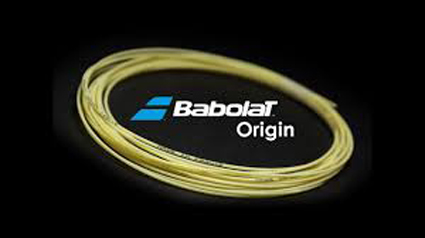
Fifty year old teaching pro who played college tennis in the eighties. Debilitating wrist pain. Rested and iced. Got off the poly for a month, in favor of a full bed of a multifilament at 45 pounds. Hated the soft feel. Switched to a smaller grip. Tried Babolat Origin (soft nylon monofilament) at 42 pounds and loved it. Success. Went to a lighter, oversized, more flexible frame. Even more success.
Ranked Senior Player
Thin, ranked senior player with small hands, and sensitive elbow, and a shoulder that hurts daily. Hits fairly hard. Opponents hit harder. Hates the flexible, heavier frames favored by his favorite players, Stan Wawrinka and Andy Murray.
Enjoys a stiff 285 gram frame. Loves the spin of polyester. Will not spend the bucks on gut. Tried a thick 15L gauge Tecnifibre multifilament main, with a hard poly cross. After rest, and finally arriving at the right tension (50/45), Success.
3.5 Woman
This is an odd one. Petite 3.5 woman, 5 ft 2, 110 lbs, suspect technique, virtually no serve, so she sold herself on a pair of extended length frames. Earned her way up to 4.0. Played daily. Elbow pain. Advil addiction.
Didn't want to buy new frames, but decided to demo the standard length version of her Yonex. Strings not an issue as she was using a soft multifilament at 50 pounds. Regretted buying the longer frames recognizing the additional leverage and stress on impact.
Was unsure about spending the money on new frames. I removed the grips and buttcaps. Sawed off 1 cm. Replaced buttcaps and grips. Success. She is considering shortening another cm.
High School Player
Sixteen year old high school player. 6 ft 3, 180 lbs, fit, strong. Loves his Prestige from three years ago when he was little, and the size 2 grip fit well. Wrist pain from forward snapping motion on the serve.
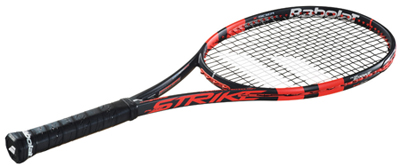
Full disclosure, I am also his coach. He rested. Got away from the snapping. Got back into more of a long axis arm rotation and much cleaner technique. Got rid of the leather grip in favor of a synthetic grip. Got a trio of Pure Strike Tours in size 3. Back to leather. Success. Back competing.
4.5 Man
And one more case study that has nothing to do with injury. A 4.5 player with clean technique fell in love with a stiff, sub 300 gram frame. Used gut mains and poly crosses for the exceptional power and spin. Was not thrilled with the lack of durability. Switched to poly mains and gut crosses. He couldn't tell the difference, and it lasted twice as long.
As you can tell there is no one solution for every player. There are too many factors in play from playing level to technique to frames to string compositions to string combinations to tensions.
But if you have struggled occasionally or regularly with arm pain, I hope you find some ideas in these examples that might work for you. My final thought. Work with a stringing technician who really understands the range of variables and option. This could save a lot of expensive experiments.